Non-native mammals negatively affect rates of native frugivory in the Eastern Caribbean islands
2023-2024
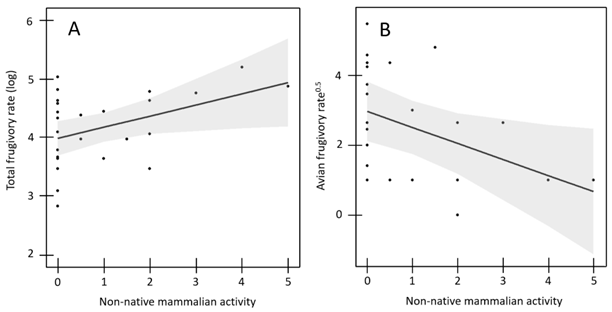
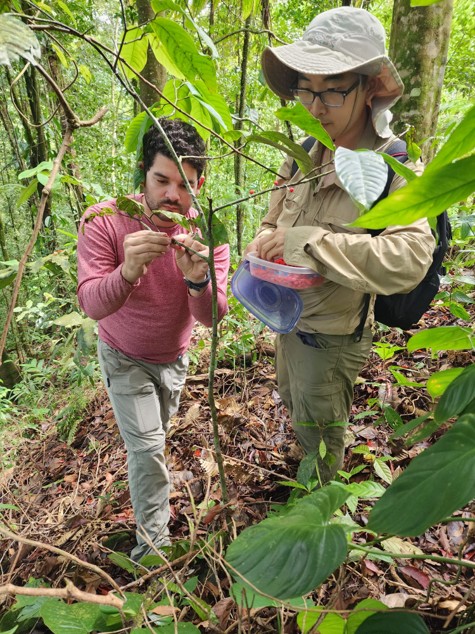
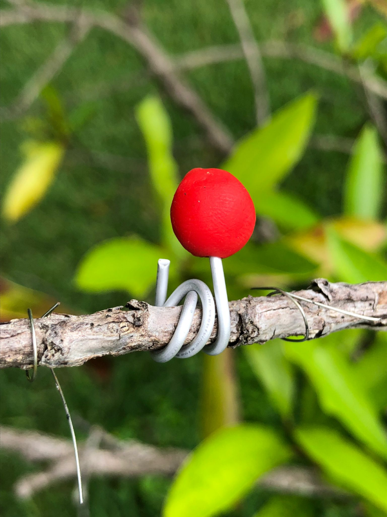
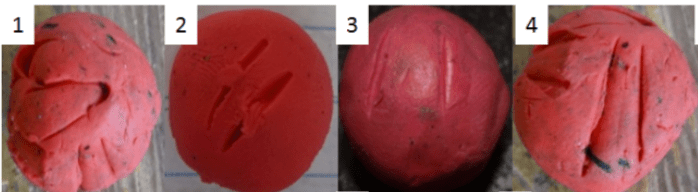
Biotic invasions represent one of the leading environmental threats, with non-native mammals being particularly damaging to native biodiversity on oceanic islands. One way that such damages have occurred is through the disruption of frugivory, a fundamental process for plant reproduction and healthy ecosystem function. To investigate such disruptions, we explored (1) the magnitude of non-native mammal frugivory activity, (2) whether non-native mammal activity levels affect native frugivory interaction rates, and (3) which local, biotic, biogeographic, and socio-economic factors best predict non-native mammal frugivory levels. We used artificial fruits and camera traps to measure native and non-native frugivory interactions on 13 islands in the eastern Caribbean, an important biological hotspot. Overall, we found that non-native Rattus sp. were responsible for nearly 80% of all frugivorous activity detected by camera traps and that increased non-native mammal activity led to significant declines in avian frugivory rates. Non-native mammal activity, in turn, was positively associated with road proximity and neighboring island proximity, illustrating that both human activity and island geography influence non-native mammal frugivory interactions. These results suggest that non-native mammals are dominating frugivory dynamics in understory vegetation in the eastern Caribbean, with consequences for native frugivory interactions. Given the generally seed predatory behavior of Rattus sp., we argue that plant dispersal could be negatively affected on islands with abundant non-native mammal populations. Thus, we emphasize the need for controlling non-native mammal populations and highlight the diverse inter-trophic effects that non-native mammals can have on insular tropical ecosystems (Kim et al. in review).
Acknowledgements
I would like to thank my co-authors for this project. Fabio L. Tarazona-Tubens, Maximilian Vollstädt, Fernando Gonçalves, Emmeli Agerskov Claré, Andreas Krogh Norrild, Hanna Welzel, Tianying Zhang, Mark Hulme, Christopher Kaiser-Bunbury, Mauro Galetti, Benno Simmons, Bo Dalsgaard, and Christopher Searcy

